
What Itawamba County Deed Records Convey
Each recorded deed names the parties. It describes the land. It also states what kind of instrument it is. The filing reference ties it to the book and page where it lives. That makes a deed the strongest recorded proof of a transfer. Still, it should be read alongside related instruments. Estate or chancery proceedings can also touch the same tract.
| Deed Type | What It Does | Common Use |
|---|---|---|
| Warranty deed | Conveys the described interest with stated covenants | Ordinary sale |
| Quitclaim deed | Conveys whatever interest the grantor has | Family or interest cleanup |
| Executor or trustee deed | Conveys through a fiduciary | Estate or trust |
| Tax-sale instrument | Documents a delinquent-tax process | Tax sale research |
| Corrective deed | Corrects an earlier recorded detail | Description or name repair |
A deed passes an interest in land. Other instruments burden it instead. Deeds of trust, mortgages, judgments, construction liens, federal tax liens, and lis pendens all give notice against a title. Releases, modifications, subordinations, and substitutions matter too, and each one should be tied back to the filing it modifies.
DuProcess Offers More Than Party Names
The recorder interface goes far beyond party names. You can search a Full Name in last-name-first form. A date range works too, along with quick presets like Last 7, 30, or 90 days. Instrument number, Book/Volume, Book/Page, and Parcel ID are all searchable fields. So are location, instrument type, consideration value, subdivision, block, lot, and section-township-range. Square, quarters, street number, Parcel Num, PPIN, and patent number round out the list. A single result can return grantor and grantee, filing date, page count, status, and legal description fields. It also links to related instruments, which makes building a chain from one parcel far easier.
| Search field | Use in deed research | Important limit |
|---|---|---|
| Full Name | Find grantor or grantee filings | Test variants and legal entities |
| Date / Recently Filed | Narrow a transfer period | Not a substitute for older books |
| Book/Page or Instrument | Retrieve a known reference | Copy exactly |
| Subdivision / Lot / Block | Follow platted land | Names may change |
| Parcel Num / PPIN | Cross-reference the tax parcel | Identifiers can change |
Inspect the county-linked DuProcess interface shown below.
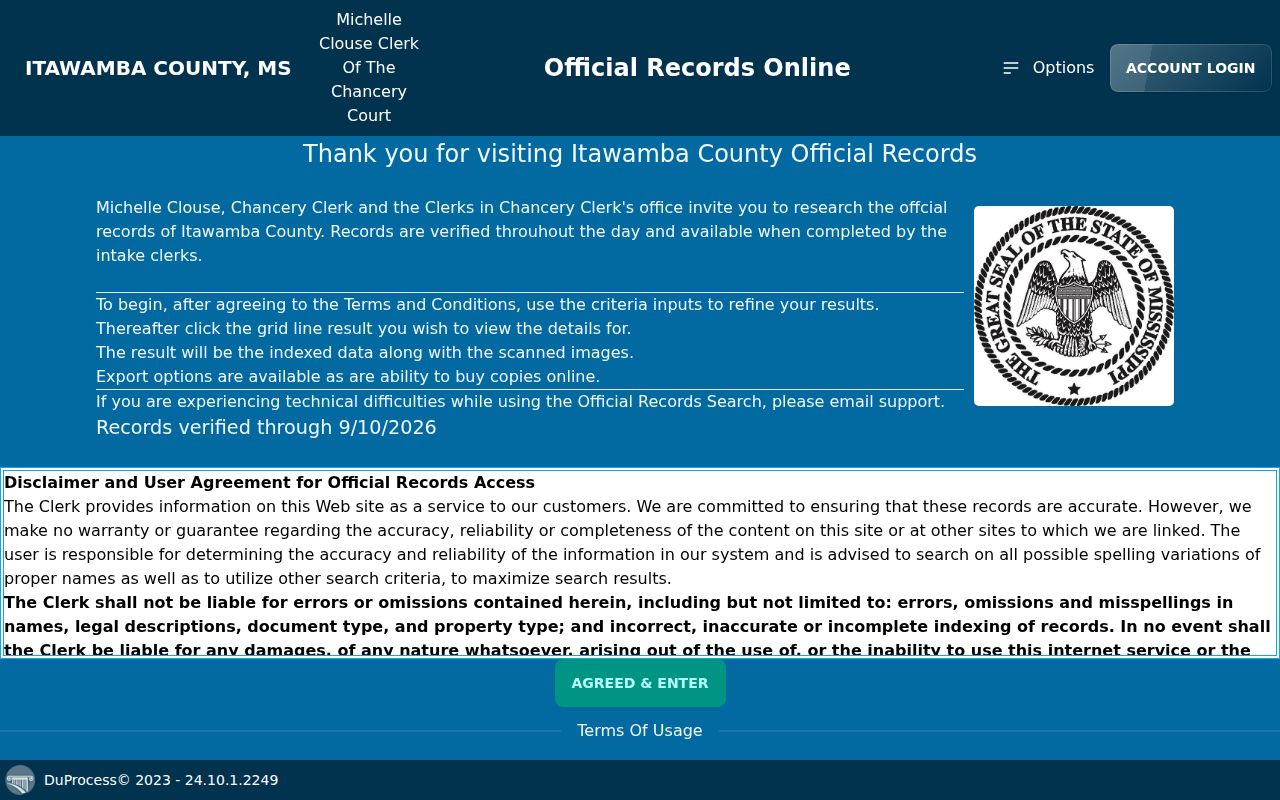
The official search page shows how those controls work together. Party, recording, parcel, subdivision, and address clues can all be combined in one query, so an anonymous result stays within reach.
The Courthouse Index Remains Official
DuProcess states plainly that its internet index is not the official courthouse index. It publishes no coverage start date and no imaging cutover. A blank result can mean a spelling issue. It can also mean a changed parcel number or an old legal description. Or it may simply be a record the index never reached. Treat the web index as a discovery tool with handy PDF export. The official record belongs to the Chancery Clerk. The Chancery Clerk also records plats, deeds of trust, mineral leases, and releases. It records liens, estates, guardianships, and land disputes too. Those related deed records often explain a title event a deed-only query misses entirely.
Note: Preserve both the modern APN and the deed’s legal description when moving between tax and recorder systems.
Instrument Types Reveal the Full Land Trail
The instrument dropdown reads like a land-record catalog. It covers deeds, affidavits, assignments, assumptions, bankruptcies, construction liens, corrections, county and municipal tax sales, declarations, deeds of trust, federal tax liens, judgments, lis pendens, mobile-home certificates, oil-and-gas filings, powers of attorney, ratifications, releases, subordination, substitution of trustee, and UCC entries. Whenever a deed leaves an interest unexplained, search those related types next. A release never proves every encumbrance has ended. Match its instrument reference, parties, legal description, and related-document links against the original lien or deed of trust. Consideration is likewise a recorded field, not a reliable gauge of market value.
Follow Itawamba’s Grantor-Grantee Index
Itawamba County deed research starts with the parties. The recorder's DuProcess index sorts recorded instruments by grantor and grantee. Searchers typically begin with a known grantee, then work backward through each grantor, logging the parcel number, legal description, filing date, instrument number, and book/page as they go.
- Locate the newest acquisition deed with the present owner as grantee.
- Read the grantor, filing date, legal description, parcel clues, and recording reference.
- Search that grantor as an earlier grantee and verify that the land matches.
- Repeat until the web index ends, then use the official index or older deed books.
- Grantor
- The party conveying an interest.
- Grantee
- The party receiving the stated interest.
- Chain of title
- The linked sequence of conveyances for the same land.
- Book/Page and instrument number
- References used to retrieve a filed document.
Early Deed Books Start With the County
Itawamba County dates to 1836, and the Historical Society documents Deed Books 1–2 covering 1836–1839. Fulton’s title story began with fifty acres donated to the county Board of Police in 1837. Town lots were then sold in 1838. Early deed research may therefore turn on town-lot language and federal survey calls. It may also turn on historic place names rather than a modern street address.
The Society’s “Early Deeds of Itawamba County” helps plot those old descriptions. It also includes multiple indexes. For records beyond the web portal, the Mississippi Department of Archives and History offers county-record and microfilm guidance. The county records no courthouse fire or specific destruction event. So gaps in early deed books should not be attributed to one.
Probate Can Interrupt a Simple Deed Chain
The 1836-to-1900 Chancery Index enumerates 996 probate packets. It flags 358 of them missing, leaving roughly 64 percent represented as surviving. An index entry, in other words, does not guarantee a packet still exists. Surviving files sit in numbered cabinets at the Fulton courthouse. The clerk can furnish typewritten copies. Executor deeds, estate orders, guardianships, and chancery proceedings often explain how an interest moved. They matter when no ordinary buyer-seller deed appears. Cemetery records, newspapers, and directories help sort out parties. They supply identity context, though, not land-title proof.
Inside Donation Is a Local Search Clue
DuProcess keeps subdivision choices such as Inside Donation and Outside Donation, plus Beaver Lake, Lake Itawamba, Scenic Hills, Sheffield, Southern Oaks, Tipco, White Springs, and many more. Those values do real work. A platted name with lot and block can recover deed records when a street changed or never appeared in an old instrument at all. Rural land calls for section, township, range, quarters, and parcel clues instead. Compare the description across successive deeds each time. A shared surname or a nearby tract alone never extends a chain.
No Current Itawamba Fraud Alert Was Located
The county Chancery Clerk page offers no property-fraud alert signup at present. Mississippi Senate Bill 2751, introduced in 2026, proposes a Deed Fraud Prevention Act that would require alert systems by 2028, but its official text still carries the label "As Introduced." So it remains a proposal, not an enacted local service. Until Itawamba County offers an official alert system, owners can review recent filings from time to time and contact the clerk about any unfamiliar instrument. Read the proposal's official status and text for the current state of the bill.
Obtain an Itawamba County Deed Copy
Online images come through DuProcess as a paid convenience. Credit-card transactions carry a 3.5% service charge with a $2 minimum, and purchases are final and nonrefundable. For an official or certified copy, contact the Chancery Clerk at 201 W Main St, Fulton, MS 38843, 662-862-3421; listed hours are Monday through Friday, 8:00 to 5:00.
Recording fees are separate from copy charges. Deeds, deeds of trust, powers of attorney, and other non-attachment instruments cost $26 for the first five pages plus $1 per additional page. Releases, modifications, and attachment instruments cost $27 per attached instrument number.
Recorded, not guaranteed. The Itawamba County deed index shows filed instruments, not a title opinion. Unrecorded interests, defects, or related court matters can still exist.