
Trace Itawamba County Former Owners
Begin with the newest deed that matches your parcel number and legal description. The grantor named there is your first former owner. Next, search that name as a grantee to locate the deed from the Itawamba County deed records. It shows how the prior owner acquired the land. Work that same step, deed after deed. The chain of title in Itawamba County property records grows steadily clearer.
| Transfer point | Grantor to grantee | Deed type | Chain key |
|---|---|---|---|
| Newest matching deed | Immediate former owner to current owner | Read the instrument | Legal description and book/page |
| Prior acquisition | Earlier owner to immediate former owner | Read the instrument | Same tract wording or valid split reference |
| Next backward link | Earlier grantor to that prior owner | Read the instrument | Plat, parcel, and related instruments |
| Pre-web continuation | Repeat through official deed books | Deed, order, or estate transfer | Official index, book/page, legal description |
Treat this sequence as a method, not a claim about transactions nobody has checked. Fill every row from the actual instruments for the parcel. The web index works well for a recent starting point. Once the trail reaches the nineteenth century, early books and indexes take over. Tax rolls, census entries, and directories can help. Cemetery records and newspapers help too. Together they separate two people with similar names. None of them transfers title, though. Each one simply points back to the deed, probate order, or recorded plat.
Reverse the Itawamba Deed Chain
The county-linked DuProcess grantor-grantee search serves as the modern working index. Enter the current owner as grantee first. A common name may return too many results. Filter by parcel, PPIN, legal description, subdivision, lot, block, street, or book and page. The search page also displays recently filed documents beside book/page, instrument, legal-description, and address options.
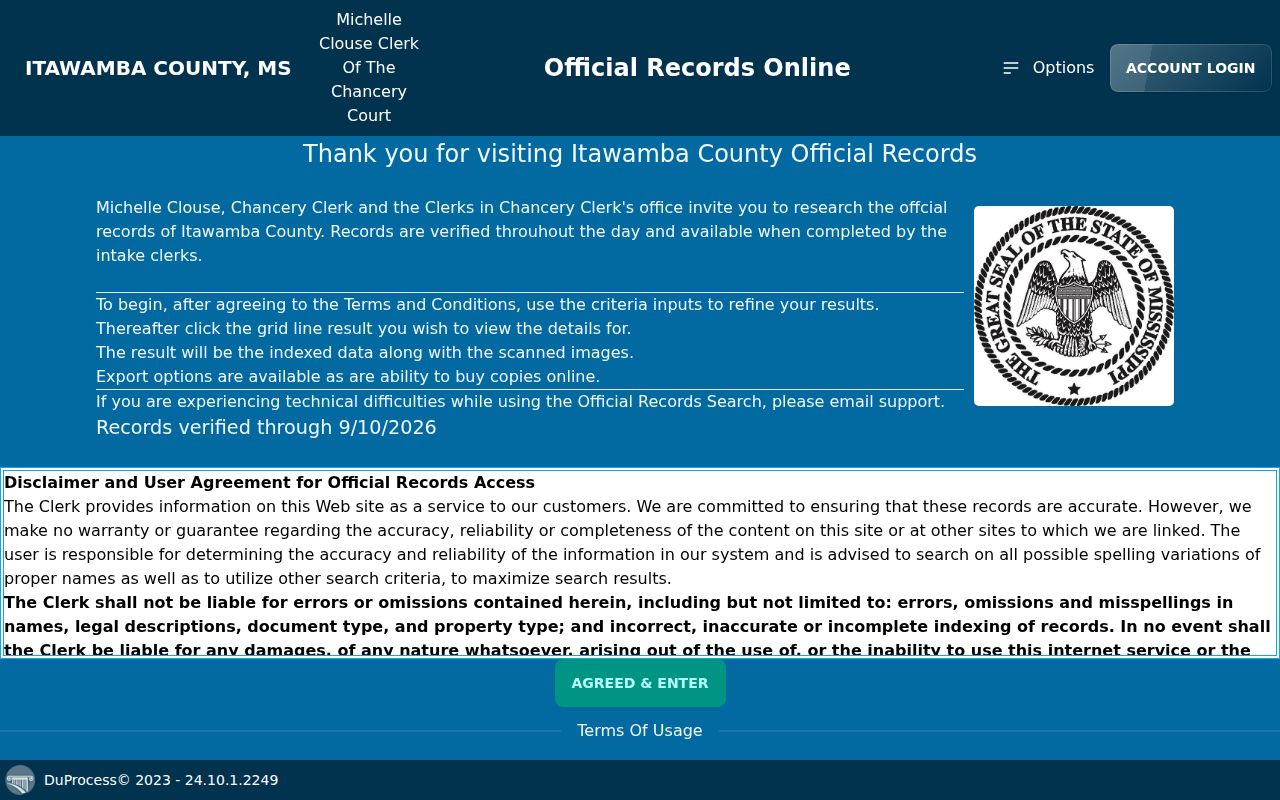
Those fields make a backward chain possible. Each matching deed names the prior grantor and the new grantee. Exported index data remains a finding aid only. DuProcess itself warns that the courthouse index is the official record.
Walk Itawamba Ownership Backward
Work one transfer at a time. Never gather people with similar names and line them up by date without matching the tract. Each step should preserve the legal description, any parcel reference, the instrument type, the filing date, and the book and page.
- Find the current owner's acquisition deed, with that owner shown as grantee.
- Read the grantor and confirm that the legal description matches the subject tract.
- Search the grantor as a grantee to locate that former owner's acquisition.
- Repeat until the web trail ends, then continue through official deed books and indexes.
- Grantor / grantee
- The conveying party and receiving party named in a deed.
- Chain of title
- The ordered sequence of instruments transferring the same land.
- Reverse index
- An index organized to find a party in the opposite role, useful when stepping backward.
- Legal description
- The land wording that survives when street names and parcel numbers change.
Itawamba Deed Books Begin in 1836
Itawamba County dates from 1836, following the Chickasaw Cession. The Historical Society documents Deed Books 1 and 2 covering 1836 through 1839. Its "Early Deeds of Itawamba County" material shows how to plot old descriptions. It also supplies indexes that bridge from named parties to original land wording.
When the online search stops, save the last reliable grantor, grantee, book and page. Keep the description too. Ask the Chancery Clerk for the official index and the book itself. DuProcess publishes no stated start year or imaging cutover. No specific online cutoff should be promised.
Access reality. Online copies are convenient and paid, while the courthouse index controls and early books may require clerk, Historical Society, or archival access.
Probate Can Bridge Former Owners
A former owner may have died with no simple deed from that person to the next name. Estate files, wills, inventories, orders, and heirship material can explain the transition. The Historical Society's 1836-1900 Chancery index enumerates 996 probate packets and flags 358 as missing, leaving roughly 64 percent represented by surviving packets. An index entry never guarantees its packet still exists. Surviving files sit in numerical cabinets at the Fulton courthouse, and typewritten copies may be requested from the clerk. Keep spelling variants and the estate number close at hand. Then tie any probate finding back to the deed or court order affecting the parcel.
Note: A family relationship explains identity, but it does not by itself prove that an heir received this tract.
Historic Names Hide Itawamba Owners
Address searching grows weaker as the chain moves back in time. Fulton may hide inside original town-lot wording from the 1837 donation and 1838 sales. Mantachie records may say Lone Star or Center Star. The town moved south in the 1880s. Tremont material may point to Stone's Crossroads or an older Bankhead Highway name.
Treat each place name as a search variant. Cover deeds, plats, newspapers, directories, and local indexes. The legal description must make the final match. A church record, school source, or newspaper notice can separate two former owners with similar names. But it supports identity rather than title.
Plats Track Changing Itawamba Tracts
A subdivision plat can explain why one old tract became several current parcels. DuProcess searches by subdivision, lot, block, parcel, legal description, and instrument type. If no map image appears, ask the Chancery Clerk for the recorded plat. Ask for its citation too. AxisGIS shows current tax-parcel context, yet it proves no legal boundary. Compare it against the plat and each deed description. Parcel numbers can change after a split or a combination. Book and page references, along with the calls in the legal description, form the safer bridge across those changes.
Verify the Itawamba Former-Owner Trail
DuProcess sells paid copies online and adds a 3.5 percent card service fee, with a $2 minimum. All sales are final. So narrow the chain first. Use the index fields to settle which deed records actually matter before ordering a stack of images. Ask the clerk whether an ordinary copy or a certified copy fits your purpose, since certified copies carry weight for formal uses that plain copies do not.
The Chancery Clerk at 201 W Main Street in Fulton remains the official fallback when the online index leaves questions. The county page lists 662-862-3421, and the linked system posts weekday hours from 8:00 to 5:00. A good request names the parties, the approximate year, the deed type, the book and page, and the legal description of the parcel.
Depth of Itawamba Ownership Records
Itawamba County land records reach back to the county's founding in 1836, but no official source promises that every instrument is online or that every historic file survives. The ownership trail is layered. Courthouse books and packets sit at the base. Above them sit Historical Society abstracts and indexes, Mississippi Department of Archives and History material, and modern vendor searches for parcel and deed records.
No courthouse fire, flood, or destruction event appears in any record. Resist the urge to invent one to explain a gap. A missing hit in a property search can simply mean thin coverage, an indexing quirk, a spelling variant, a changed legal description, probate activity, or a packet that is not available. Test those routes one by one. Then state any unresolved gap plainly rather than papering over it.
Lawful use. Research former Itawamba County owners for property history, estate work, title review, or purchase diligence. Never use owner names or addresses to stalk, harass, intimidate, or harm a living person.
A reconstructed chain of ownership stands only as firm as its parcel match and the official instruments behind it. If legal ownership, an easement, or a boundary becomes disputed, get the controlling deed records and qualified advice. An online index is never a title opinion.